
Why use 10 words when 100 will do?
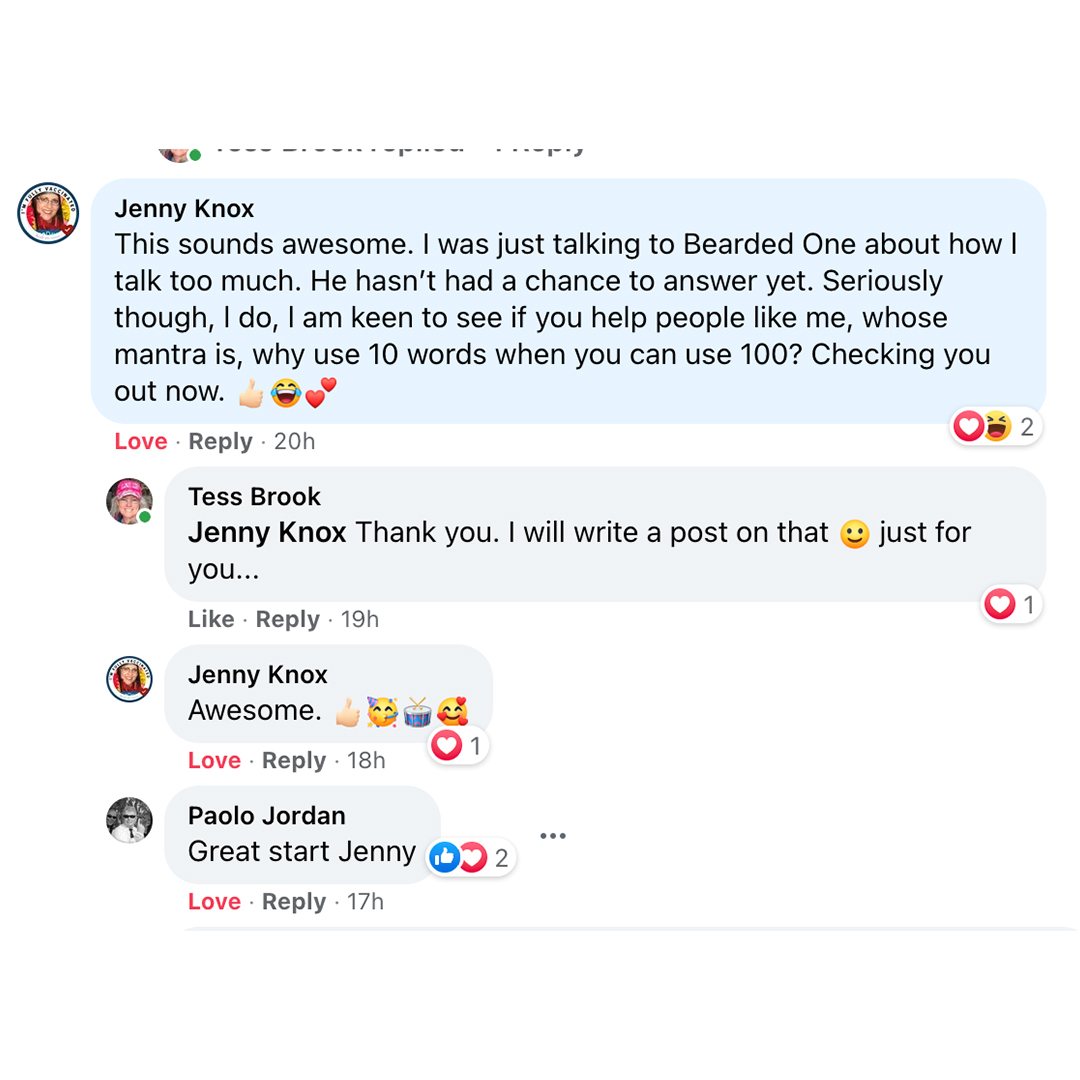
I was asked; ‘Why use 10 words when 100 will do?’ when I put the call out for topics for my blog.
The request came from the lovely Jenny Knox, aka ‘The Giddy Aunt’. If you want a laugh you need to check her out.
She asked,
‘I was just talking to Bearded One about how I talk too much. He hasn’t had a chance to answer yet. Seriously though, I do, I am keen to see if you could help people like me, whole mantra is, why use 10 words when you can use 100?’
As you can see the question was a little tongue in cheek.
From a communication perspective, why use 10 words when 100 will do is worth pondering… Here are my thoughts. It is about meeting people in their zone.
First and foremost, the answer lies in context.
- What does your audience need, 10 words or 100 words?
- What time constraints are you and others under?
- Are you stealing other people’s airtime?
Tip; If someone is taking too much time, introduce the concept of a talking stick that gets passed between speakers. Queue people if need be. E.g., You’re next, next, next etc. This can be done successfully online as well. Worst case scenario the meeting host can mute them, either owning it or declaring there was a technical issue.
Secondly, will 10 words or 100 words create the connection and engagement you seek?
This requires a deeper dive.
- Story telling reenforces relatability
- Relatability creates connection
- Recapping helps bring people back to the same starting point, however it can be overdone, especially if it is used to push or justify a position or view. (Let the facts speak for themselves). Otherwise, you will lose your audience and no number of words will bring them back.
- If 100 words is your style, go for it. Observe your audience and their level of engagement.
The third is, how much leeway and tolerance will others give you?
We:
- All have a tolerance level before we switch off.
- Unconsciously give some people more leeway than others. (Another tip for you. If you are a manager be careful not to be seen to be biased by giving one person more leeway than another – been seen to favourites has its own issues).
In a nutshell, your audience will give you permission, or not.
It may be obvious that they are engaged and listening. They may be practiced at zoning out and the notes that they are taking is really their on-line shopping list that they have been meaning to do for days.
Observe the communication style of others, and what works for them. If you are uncertain how you are being received and want a more definitive answer, ask them for feedback. Thank them for their answer and ponder the gift they have given you without justifying your style. You can accept, reject or incorporate their feedback. If a slight adaption could give you a better outcome, consider trying it. Whatever you do, don’t be someone you are not.
Back to Jenny, she is a wonderful storyteller, and I would totally feel robbed if she changed her style.
Jenny, like other classic comedians (say Dave Allen or the Two Ronnie’s), is able to bring their story back on point and keep us engaged in the process. And the Bearded One, is either engaged, practiced at zoning out, or a tolerant man. All of which makes him a keeper.
___
Tess Brook is a communication specialist and author.
She transforms organisations by creating awareness of our communication needs, differences and patterns via her signature workshop, ‘The Trouble with Talking’. Exploring the challenges of meeting each other in their zone is featured in her workshop. Reach out to Tess to learn more about this workshop. Tess@cohesiveconversations.guru
When she is not transforming organisations, she can be found discovering a new corner of the world to sit and write. She and her husband love rummaging through old bookstores for gems. They live on their sailboat Saboteur with their two dogs and Zac the cat.