
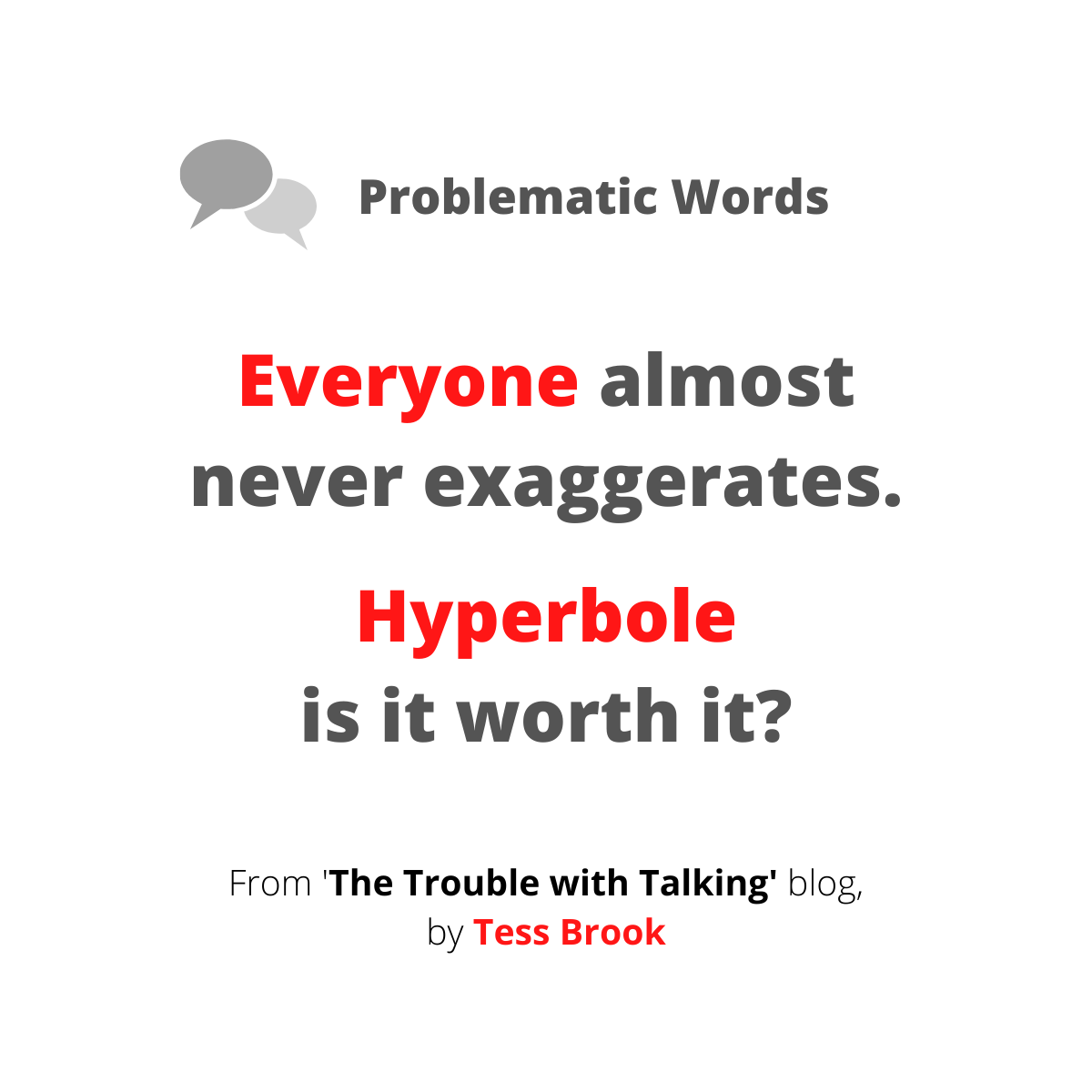
The word ‘everyone’ is problematic: Have you ever heard a co-worker say, ‘Everyone thinks…’ You look around the room. Two of your co-workers drop their heads and start shifting in their chairs, a third rolls their eyes at another and someone else looks at their watch and starts tidying up their things. Then you realise you are clenching your teeth. You start to fidget and tidy up your things ready for a swift getaway.
Your mind is going, ‘I was not consulted. They don’t know my views. How dare they represent me in that way.’ You are annoyed for the rest of the meeting and can’t wait to leave.
When you do, you avoid eye contact with the person who made the statement and make a mental note of who is gathering around the statement maker as they collectively congratulate themselves.
Why is using the word ‘everyone’ problematic?
As a word is it problematic because it is an assumption that could leave some feeling misrepresented. Perhaps even manipulated. Furthermore, it is:
- a deletion – context is missing
- a universal – applied to represent all
- a distortion – it mis-represents the view point.
Another consideration is that the user is trying to present an ‘emotionally weighted’ argument which, in itself, is detracting from the power of the message.
My suggestions would be, to focus on communicating the various views for all to see and discuss.
Instead of, ‘Everyone thinks / feels (this is wrong)’….
Try, ‘Some of us are concerned about… ‘ and present the situation and why it is a concern.
It will help others see different views, keep it conversational, rather than a statement, and will make it easier to discuss and move forward.
The use of universals could also infer judgement.
As does the use of the words ‘Right’ and ‘Wrong’, and I will cover these under their own post.
When can you use a universal? When they are true. e.g. Everyone who is alive needs oxygen? It is a fact.
We often hear universals at home in expressions such as,
- You always leave the toilet seat up! Always, no I don’t! you protest.
- You are always late. Yep, well you are not always on time!
- You never pick up your shoes. Never! Never, at least my shoes are size 7 not eleven!!!
On a personal note… My husband used to say the last expression to me a lot. I made sure that I picked up my shoes and then, when he tripped, I would quietly say, Who’s shoe’s did you trip on baby?
While I joke now, and it is banter at home, universals have the potential to split the work place, especially if it is an assumption or misrepresentation of other people’s views.
The challenge is that most people will not ask the person using the universal to be more specific. And if we are triggered, it is even harder to do politely and professionally without being seen as attacking the other person.
Here are some tips to try:
Publicly focus on the issue not the universal. e.g. Can you expand on why it is an issue? What are you most concerned about?
Privately catch up with the person who uses a ‘universal’. Or give them this article. You could ask permission to give feedback and explain your concern about using a universal. You could explain that it depowers their message. As I said you would do this privately, of course.
___
Tess Brook is a communication specialist and author.
She transforms organisations by creating awareness of our communication needs, differences and patterns via her signature workshop ‘The Trouble with Talking’. Problematic words feature in her workshop. Reach out to her learn more about this workshop. Tess@cohesiveconversations.guru
When she is not transforming organisations, she can be found discovering a new corner of the world to sit and write. She and her husband love rummaging through old bookstores for gems. They live on a sailboat with their two dogs and cat.