
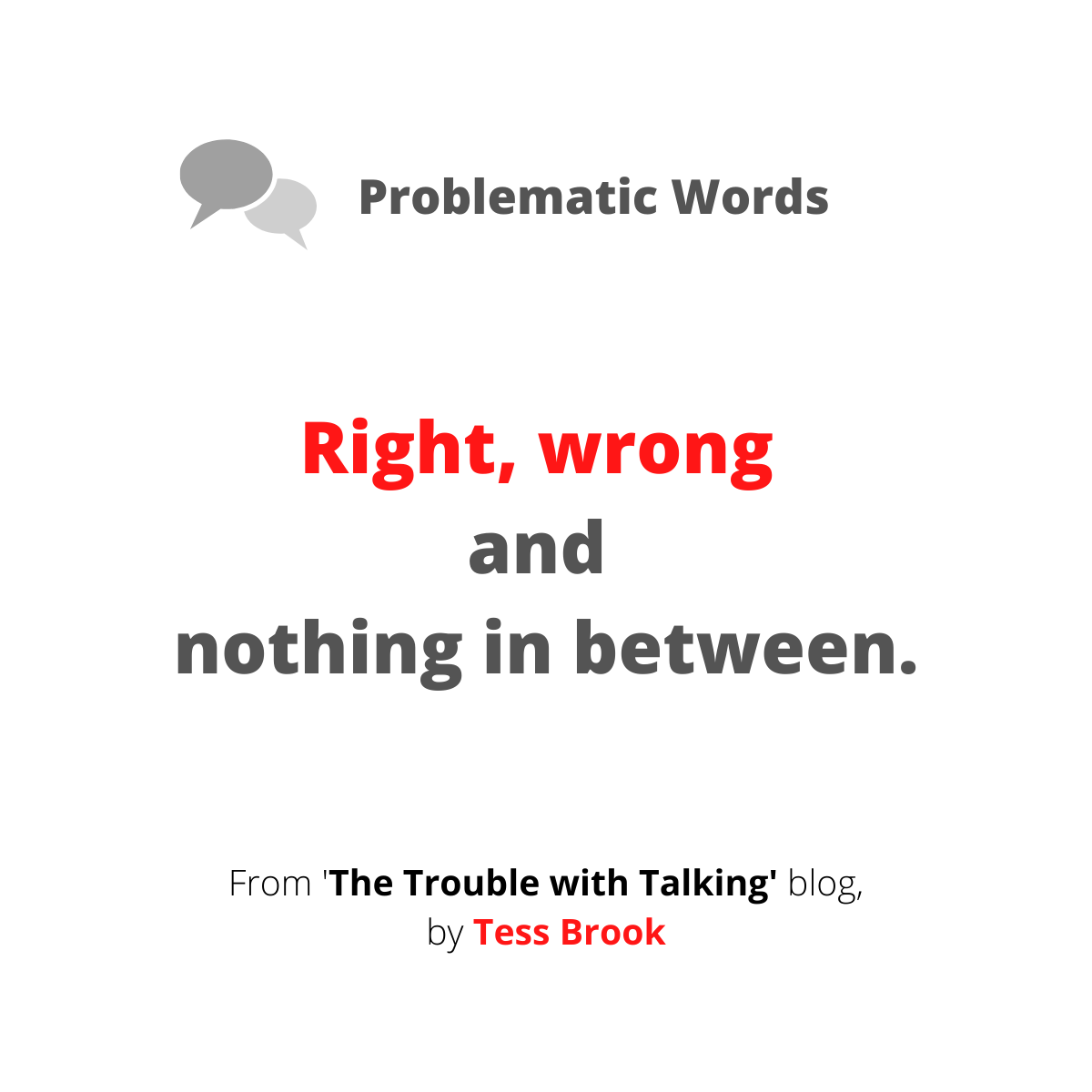
Why are the words ‘right and wrong’ problematic?
As words, they are problematic because they are dismissive. This means you are showing indifference or disregard to others.
By saying to others,
‘You are wrong!’
You are doing two things, you are:
- Stating that you are right
- Dismissing the other person view.
Additionally, unless the other person agrees that you are right, you risk shifting the discussion from a conversation to an argument involving two different viewpoints.
Perhaps the viewpoints need to be explored. My question for you is this: is stating someone is wrong a constructive way to go about it?
Some suggestions instead of saying ‘right and wrong’:
1. Cease – Making statements at all.
2. Be curious – Find new ways to explore the different views.
Example
Avoid: In a nutshell I hear what you are saying, but I am sorry, you are wrong.
Suggestion: As I see it, what I am concerned about… How would you approach that?
___
Avoid: You could do that, however it won’t work
Suggestion: Have you considered x? (Depending their response) I am curious to know how you would approach it.
___
Did you notice the difference between the two sentences?
… ‘but I am sorry, you are wrong’ and ‘however that won’t work’ are statements.
‘Have you considered…’ along with ‘I am concerned about… ‘, both give more information that now exists outside of your head.
This is followed by either, ‘I am curious to know…’ or, ‘How would you approach that?’
The question is not intended to be challenging, it is merely seeking more information. This is not intended to gather more information to prove them wrong; more so to have a shared understanding of the views of others and in doing so, keep the discussion a two-way conversation moving forward.
One final tip.
I have said previously it could be helpful to buddy up: I know from personal experience how hard changing my vocabulary is. When a word or phrase is frequently used, it can tend to be used subconsciously. If you are like me, you may not have full awareness of what you have just said and the words you are using.
___
Tess Brook is a communication specialist and author.
She transforms organisations by creating awareness of our communication needs, differences and patterns via her signature workshop ‘The Trouble with Talking’. Problematic words feature in her workshop. Reach out to her learn more about this workshop. Tess@cohesiveconversations.guru
When she is not transforming organisations, she can be found discovering a new corner of the world to sit and write. She and her husband love rummaging through old bookstores for gems. They live on SB Saboteur (yacht) with their two dogs and Zac the cat.